Fuel Depot Red Flags: What Investigators and Buyers Should Watch
· Report Fuel Editorial Team
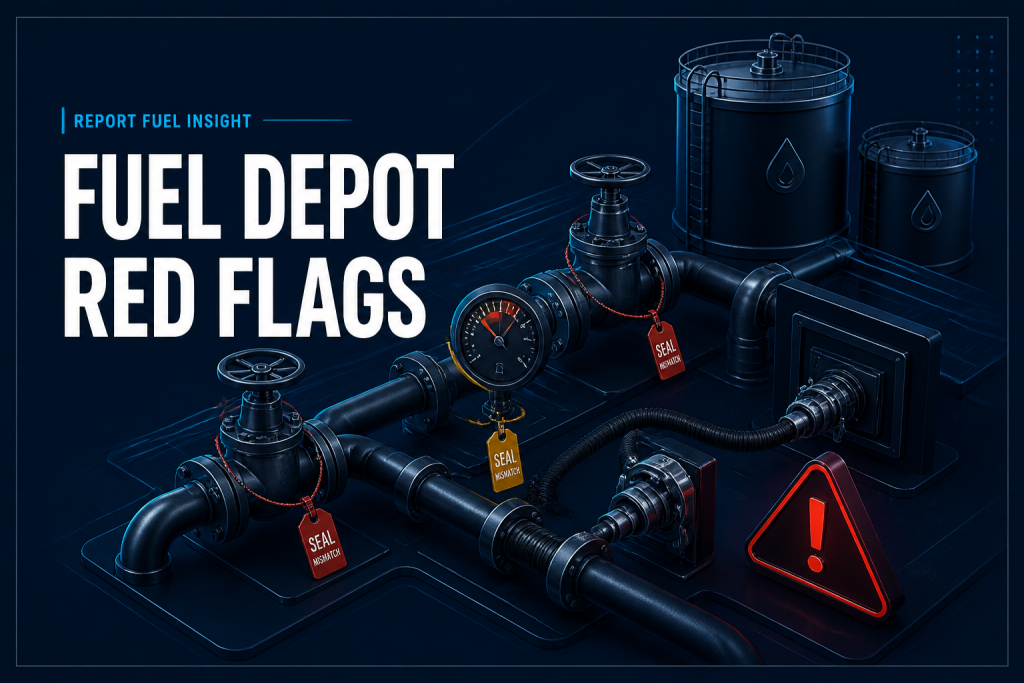
Depot anomalies become meaningful when they form patterns across product movement, documents, access and money.
This guide is educational and does not replace legal, technical, safety or regulatory advice. Apply current South African law, licence conditions, contracts and site procedures to the facts.
Physical and operational anomalies
Unlabelled tanks, temporary hoses, unexplained mobile equipment, unusual night activity, frequent seal changes, disabled cameras and restricted access to ordinary control points deserve documented explanation.
Remain outside unsafe or unauthorised areas. Observers should never create risk to capture evidence.
Stock and quality anomalies
Persistent gains or losses, unexplained density movement, repeated water or contamination complaints, missing retain samples and undocumented tank transfers can indicate control failure.
Compare measured data with calibration status, temperature correction and legitimate operational causes before drawing conclusions.
Document anomalies
Look for duplicated delivery-note numbers, inconsistent fonts or timestamps, loads exceeding apparent capacity, vehicle details that change across copies and records created after the event.
Preserve originals and obtain system exports where authorised.
People, routes and payments
Repeated use of unapproved drivers, unexpected route stops, third-party payees, split invoices, urgent bank changes and employees bypassing segregation of duties can connect operational and financial risk.
Analyse relationships carefully and apply procedural fairness; association alone is not proof.
Escalation
Use a defined threshold to quarantine stock, pause payments, preserve data and appoint independent reviewers. Keep allegations confidential and need-to-know.
Build the base with 25 depot due-diligence questions.
Practical next steps
- Protect people, product and time-sensitive evidence.
- Record facts and preserve originals.
- Verify entities, licences, source and transaction records independently.
- Use competent testing or professional advice where the risk warrants it.
- Report through a safe, appropriate channel.
Frequently asked questions
Does one red flag prove a crime?
No. It triggers verification, not a conclusion.
May I photograph a depot?
Only where lawful, safe and authorised; never trespass.
What records should be prioritised?
Time-sensitive CCTV, access, loading, seal, stock and GPS records.
Authoritative references: SARS: non-compliance, adulteration and illicit trade; South African Government: petroleum services and licensing; Petroleum Products Amendment Act 2 of 2005. Regulatory facts should always be checked against the latest official publication.